
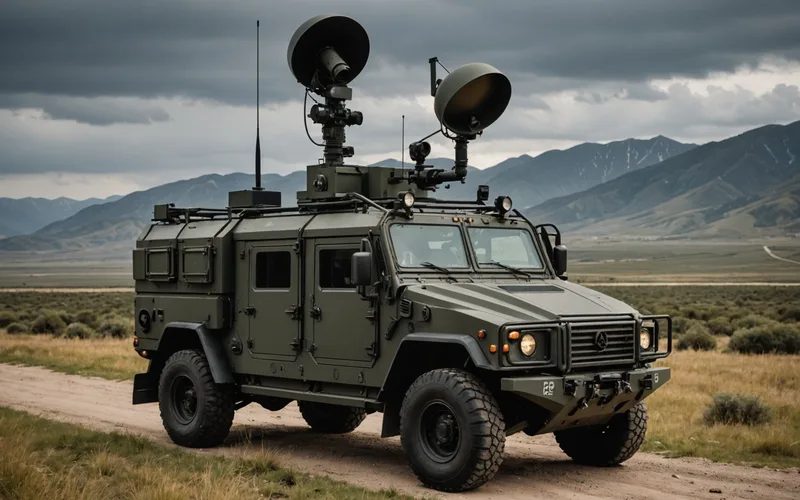
A commercial Ka-band PA designed for a very small aperture terminal at a fixed ground station and a PA intended for a SATCOM-on-the-move terminal installed on a tactical ground vehicle may share the same frequency band, the same nominal output power rating, and even the same semiconductor die. They are not the same component. The gap between them is not marketing or compliance paperwork. It is a set of physics-driven requirements that commercial satellite specifications either omit entirely or specify at levels that will cause the device to fail in a defense deployment scenario.
This is not a theoretical concern. Teams that have tried to adapt commercial satcom PAs directly into defense SOTM applications routinely encounter problems in temperature stress testing, vibration qualification, and long-duration RF life tests that reveal failure modes never exposed in the commercial qualification program. Understanding what those requirements are and why commercial specs miss them allows hardware teams to evaluate GaN PA candidates more efficiently and avoid specification gaps that surface late in program development.
Temperature: The Difference Between Commercial and Military Bands
Commercial satellite ground terminals are typically specified for operation between minus 10 and plus 50 degrees Celsius at the outdoor unit, consistent with a fixed installation with some degree of environmental protection. The PA inside that terminal is likely characterized at room temperature for datasheet performance, validated across the commercial temperature range in qualification, and may not have been stressed below minus 20 or above plus 70 degrees Celsius.
A defense SOTM terminal mounted on a ground vehicle faces an ambient range from minus 40 to plus 85 degrees Celsius at minimum, reflecting military standard temperature classifications that account for cold-weather operations in high-altitude or arctic environments and hot-weather operations in desert theaters. The PA die junction temperature at plus 85 degrees Celsius ambient with maximum RF power and a worst-case thermal path can reach 180 to 200 degrees Celsius. At that junction temperature, GaN trap filling dynamics, surface passivation stability, and gate metal interdiffusion all operate at accelerated rates. A device that exhibits stable gain and quiescent current over 5,000 hours at junction temperatures below 150 degrees Celsius may show measurable degradation in 500 hours at 200 degrees Celsius.
Extended cold operation adds a different problem. Many GaN devices exhibit a trapping-related phenomenon where, after storage or operation at temperatures below minus 30 degrees Celsius, RF output power at startup is transiently lower than the steady-state value. The channel requires a warm-up period, measured in seconds to tens of seconds, before drain current and output power stabilize at their rated values. For a commercial VSAT that starts up slowly and runs continuously once on, this behavior is invisible in field operation. For a SOTM terminal that must establish a link within 10 seconds of power-on in a cold environment, it is a functional gap.
Vibration and Mechanical Stress
Commercial satellite ground terminals, including mobile consumer terminals and enterprise VSAT units, undergo vibration qualification during shipment and installation testing but are fundamentally characterized as stationary installed equipment. The relevant vibration profile is a sine sweep and random vibration simulation of transportation, not operational vibration during sustained movement.
A SOTM terminal on a wheeled vehicle, tracked vehicle, or aircraft operates under continuous structural vibration at levels defined by test standards such as MIL-STD-810. The ground vehicle profile in MIL-STD-810 Method 514 includes broadband random vibration across 10 Hz to 1 kHz for durations of tens of minutes per axis, at acceleration levels of 0.04 to 0.1 g squared per hertz in the broadband region. Helicopter installations push further. The mechanical consequence for a packaged Ka-band PA is cyclic stress on solder joints, bond wire fatigue at the die attach points, and ceramic cap delamination in packages that use braze-sealed lids.
Wire bond fatigue under vibration is a process and design variable, not just a device variable. Bond wire diameter, wire length, loop height, and the second bond termination geometry all influence fatigue life. A PA package designed for commercial applications uses wire bond geometries optimized for electrical performance at frequency; it may not be optimized for fatigue life under the vibration spectrum of a tactical vehicle. Qualification under MIL-STD-810 Method 514 reveals these failure modes. Relying on component-level vibration characterization from a commercial datasheet does not.
Single-Event Effects and Radiation Considerations
Commercial satellite terminals operate at ground level in Earth's atmosphere, where the cosmic ray flux at sea level is four to six orders of magnitude lower than in low Earth orbit. A commercial PA device is typically not characterized for single-event latchup or single-event burnout susceptibility, because the terrestrial cosmic ray flux does not produce these events at rates that commercial system designers need to budget for.
A SOTM terminal that operates in elevated-radiation environments, including high-altitude aircraft operations, polar regions with reduced geomagnetic shielding, or operations in or near nuclear threat environments, faces single-event effect probabilities that must be evaluated. GaN HEMTs are generally considered less susceptible to single-event latchup than CMOS-based power management circuits, because GaN lacks the PNPN structures that create latchup paths in complementary MOS. However, single-event burnout, a destructive breakdown triggered by a heavy ion strike in the high-field region of the device, is a real phenomenon in GaN at drain voltages above approximately 40 V. The threshold for single-event burnout in a given GaN HEMT depends on gate length, the AlGaN barrier design, and the electric field profile in the buffer.
For programs that require formal total ionizing dose or single-event effects characterization, the PA must be evaluated using appropriate radiation test protocols and the data must exist. Assuming that a commercial satcom PA is radiation-tolerant because the foundry uses a proven GaN process is not a valid starting point for a radiation-aware system reliability analysis.
Phase and Gain Stability Under Thermal Transients
In a phased-array SOTM terminal, coherent beam steering requires stable phase relationships between PA elements throughout the system's operational envelope. A commercial VSAT PA is characterized for gain and output power at a fixed temperature and may include temperature compensation in the bias circuitry to hold output power reasonably flat. It is rarely characterized for the phase variation across temperature, because phase variation is largely irrelevant in a single-element commercial terminal.
In a phased array with 16 or more transmit elements, element phase variation with temperature degrades beam steering accuracy and effective EIRP. The relevant metric is phase slope with temperature, in degrees per degree Celsius, measured at the element RF port. For array elements on a vehicle exterior that is cycling between minus 40 and plus 85 degrees Celsius as the vehicle moves from shade to direct solar loading, thermal transients at the PA can be several degrees per minute at the package case. If the PA exhibits 2 degrees per 10 Celsius of phase variation, a 50-degree Celsius thermal transient produces 10 degrees of phase error across the array's thermal settling period.
GaN-on-SiC has a thermal phase variation coefficient that is process-dependent but generally lower than GaAs, in part because the higher-conductivity SiC substrate minimizes temperature gradients across the die. For defense SOTM applications, requesting phase-versus-temperature characterization data from PA suppliers and validating it in the context of the phased array's beam steering budget is a necessary qualification step, not an optional one.
What to Specify That Commercial Datasheets Typically Omit
Hardware teams building defense SATCOM terminals should explicitly request the following from PA suppliers beyond the standard commercial datasheet parameters: operating temperature range to at minimum minus 40 to plus 85 degrees Celsius with gain, output power, and phase variation characterized at each extreme; cold-start time to rated RF performance specification; MIL-STD-810 Method 514 vibration qualification test data or a formal statement of compatibility; phase variation with temperature across the full operating range; and if radiation exposure is relevant to the program, any available single-event effects characterization data.
The design targets that Falcomm is working toward for the FA-2400 in defense SOTM configurations address each of these dimensions: full minus 40 to plus 85 Celsius operational range, cold-start time below 5 seconds, and phase variation below 0.1 degrees per Celsius across the operating band. These are design targets on a development program, not certified qualification results. However, structuring the device's development around defense SOTM requirements from the start, rather than adapting a commercial PA specification after the fact, is the approach that avoids the late-program surprises that come from discovering gaps in a commercial qualification regime when a defense program's environmental test campaign begins.