
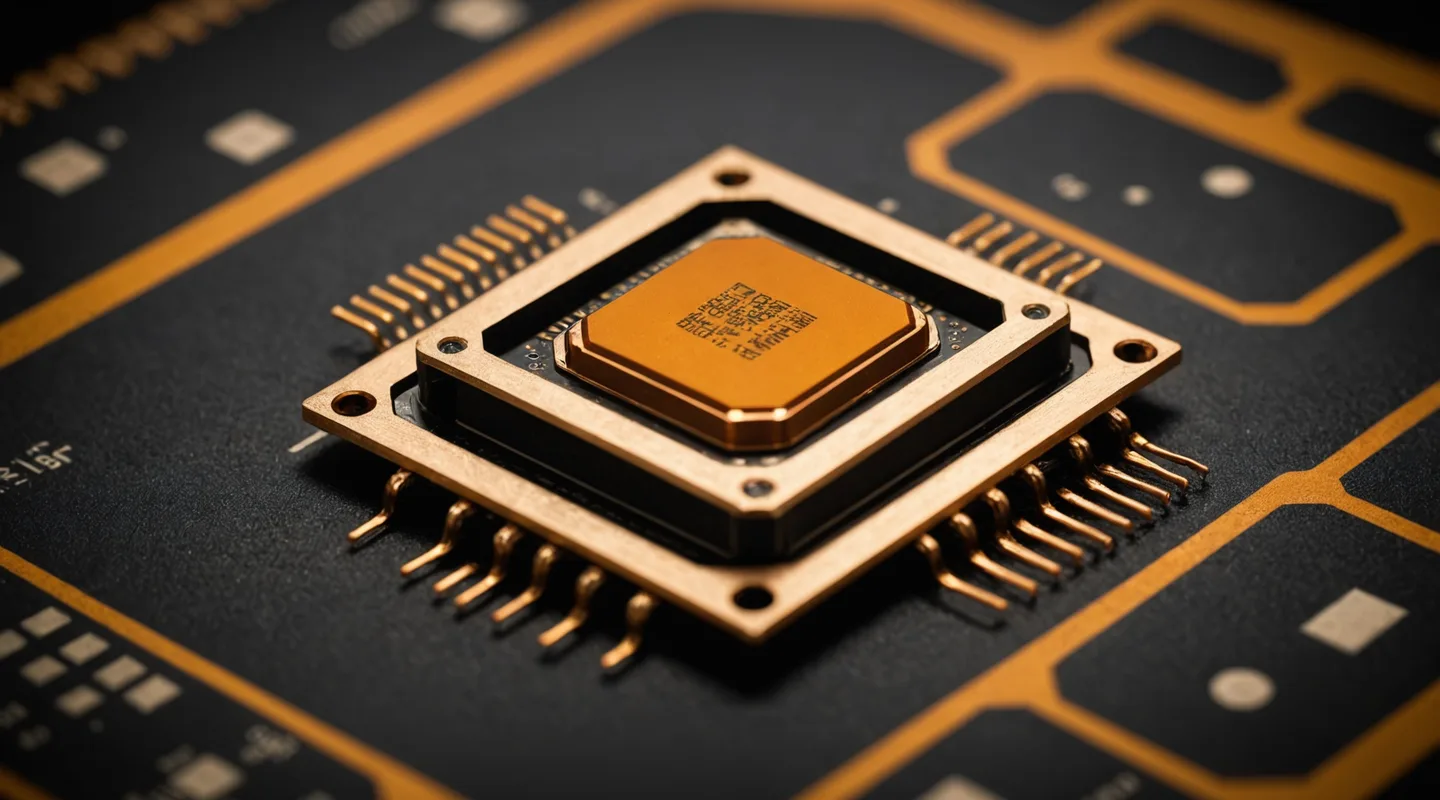
Hit satellite range on a fraction of the power. The RF power amplifier that breaks the efficiency wall.
Falcomm builds the power amplifier that lets a phased-array antenna reach satellite range while burning far less power and shedding far less heat. It is the front-end that keeps 5G and space links from staying earthbound, engineered for the makers building the next generation of satellite and 5G hardware.
Conventional GaAs loses 35-40% of input power as heat at Ku/Ka-band
Phased-array proliferation is not constrained by antenna aperture design. It is constrained by the PA thermal wall. A conventional GaAs PA running at 25 GHz dissipates more than a third of its input power as heat, forcing oversized thermal management, wider element pitch, and lower array density across every LEO terminal and 5G active antenna unit.
Falcomm's GaN-on-SiC process stack inverts this. Higher electron mobility at the gate, larger breakdown voltage, and the silicon carbide substrate's thermal conductivity of 490 W/mK, four times the thermal conductivity of GaAs, combine to push drain efficiency above 60% at band. Less heat means smaller thermal solution, tighter element pitch, and higher effective radiated power in the same volume.
View the process stack detailFA-2400 Series Power Amplifiers
Three variants optimized for distinct frequency segments within the Ku and Ka satellite bands. Same GaN-on-SiC process foundation. Differentiated by gate length, bias point, and package configuration.
GaN-on-SiC: four times the thermal headroom
Silicon carbide carries heat at 490 W/mK. Gallium arsenide carries it at 46 W/mK. That ratio is the central reason GaN-on-SiC enables a fundamentally different thermal design for phased-array front-ends.
Falcomm's process stack stacks a 2DEG channel density of 1.4 x 10^13 cm^-2 with a 25 nm AlGaN barrier, optimized for breakdown voltages above 150 V at the drain. Wider bandgap means higher operating temperature before carrier scattering degrades gain, which translates directly to sustained drain efficiency under the thermal load of a continuous-wave satellite uplink.
The through-wafer copper via array reduces die-attach thermal resistance to 0.1 degC/W, eliminating the thermal interface bottleneck that limits conventional flip-chip GaAs modules in dense phased-array tile geometries.
Full process stack documentationFour verticals where PA efficiency is the binding constraint
Every one of these applications requires RF power in a thermally constrained enclosure. PA efficiency determines whether the system closes.
Phased-array VSAT terminals and gateway uplinks running continuous Ka-band uplinks cannot afford the thermal budget of GaAs. High drain efficiency cuts the satellite terminal heat spreader by half.
Active antenna units for 5G mmWave pack hundreds of PA elements in a single panel. Every watt of wasted heat increases the mechanical cooling system, adding mass and cost to the tower infrastructure.
Airborne phased-array SATCOM terminals operate in a pressurized skin where thermal convection is limited. GaN-on-SiC's superior efficiency and junction temperature tolerance makes it the only viable PA technology at sustained Ku-band uplink power.
Electronic warfare and radar front-ends require wideband PA elements that maintain linearity under pulsed high-power conditions. GaN-on-SiC's breakdown voltage headroom and thermal stability support the duty cycles that define radar link budgets.
Test data and field feedback
"We pulled the FA-2401 into our Ka-band uplink tile evaluation because the drain efficiency spec looked like a measurement error. It was not. Running 25 W CW at 14.5 GHz, the junction temperature came in 22 degrees lower than our previous GaAs module at the same bias point. That changes the thermal solution entirely."
Hardware Systems Engineer, Orbital Dynamics GroupJunction temperature reduction at 25 W CW, 14.5 GHz vs comparable GaAs module at same bias
Design target drain efficiency at Ku-band P1dB. Bench characterization at our Baltimore RF lab under CW and pulsed conditions confirms the process architecture delivers this figure.
Evaluation samples available for qualified system integrators